
Wing Foiling for Beginners: Why It's the Easiest Wind Sport to Learn
Quick Answer: Wing foiling is widely considered the easiest wind sport to learn because the handheld inflatable wing has no lines, is simple to control, and can be released instantly if needed. You ride a hydrofoil board powered by the wing, gliding above the water. It needs only 10–12 knots to get going. Private wing foil lessons at AGK Kite School are $90 USD/hour, with a 5-hour package at $400.
If you've been intimidated by the idea of managing a kite on lines or wrestling a windsurf rig, wing foiling might be your way onto the water. It's the newest of the major wind sports, the fastest-growing, and — for a lot of beginners — the friendliest place to start. This guide explains what wing foiling is, why it's so approachable, the gear you'll use, what your first lesson looks like, and why Cabarete is one of the best places in the world to learn.
What is wing foiling?
Wing foiling (also called "winging" or wingsurfing) is a wind-powered water sport where you hold a lightweight, handheld inflatable wing that catches the wind, while standing on a board fitted with a hydrofoil that lifts you above the surface. Combine the two and you glide effortlessly, driven purely by the wind.
The sport has a longer backstory than most people realize. According to the Wing foiling Wikipedia page, the first handheld wing was invented and patented in 1981 by Jim Drake — one of the inventors of windsurfing — but the early, pre-hydrofoil versions never caught on. Slingshot co-founder Tony Logosz filed wing patents in 2004, and the sport finally exploded around 2018–2020 once lightweight inflatable wings were paired with modern foilboards. Wing gear first reached the Dominican Republic in 2020, and it's been booming in Cabarete ever since.
The three sports it combines
Wing foiling borrows the best bits of three disciplines: the wind-reading and sailing feel of windsurfing, the inflatable-wing technology and power control of kitesurfing, and the wave-riding, board-balance sensibility of surfing — all on top of a hydrofoil. That hybrid DNA is part of what makes it so fun and so accessible.
Why it's so beginner-friendly
The barrier to entry is genuinely lower than kiteboarding or windsurfing, for several concrete reasons:
• No lines. Unlike a kite, the wing has nothing to tangle, relaunch from the water, or wrap. It's just you and a handle (or two).
• Instant safety. If a gust catches you off guard, you can simply let the wing go — it depowers immediately and stays buoyant on the surface.
• Simple controls. Sheeting the wing in and out to find power is intuitive within minutes.
• Low wind requirement. A foil lifts with just 10–12 knots of wind — less than kiteboarding's 16–18 knots — so you can learn in gentle, manageable conditions.
• Transferable skills. If you've skateboarded, snowboarded, surfed or paddleboarded, the board-balance side will feel familiar.
That combination is exactly why nervous first-timers often feel more comfortable on a wing than on a kite — and why no previous water-sport experience is required to start.
The gear you'll use
Understanding the kit helps demystify the sport:
• The wing: A handheld inflatable wing, sized in square meters. Beginners typically learn on a 4–6 m² wing in Cabarete's trade winds.
• The foil board: Beginners use a high-volume board (around 100–140 liters) for maximum stability; you'll move to smaller boards as you progress.
• The hydrofoil: Made up of a mast, fuselage, front wing and rear stabilizer (the same lift principle as on the Hydrofoil Wikipedia page). A taller mast (around 70 cm+) is often easier for learning in ocean chop because it gives clearance.
• Safety gear: A helmet, an impact vest and a leash are standard — and you'll be taught to use them from day one.
What to expect in your first wing foil lesson
At AGK Wing Foil School, your lesson is built around comfort and quick progress with modern, safe equipment. A beginner session includes:
• Expert instruction from IKO-certified instructors
• Use of high-quality wing foil equipment sized for easy learning
• A thorough safety briefing covering wind, conditions and your gear
• Continuous support and feedback while you're on the water
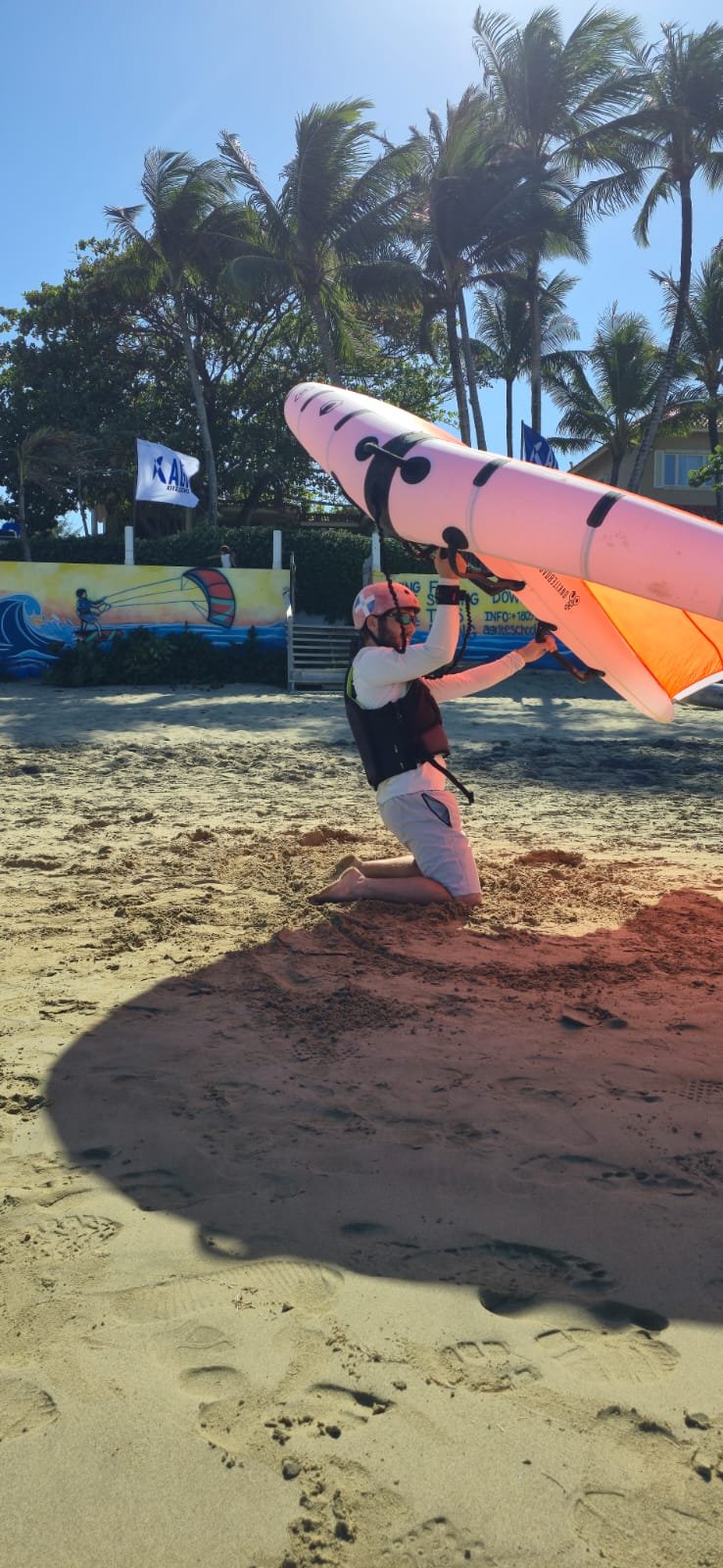
You'll typically start by getting comfortable handling the wing on land or on a stable board (often on your knees at first, with the wing held above your head and clear of the water), then progress to riding on the water, and finally to lifting up onto the foil.
The progression: wing handling to flight
Wing foiling is learned in clear stages:
1. Wing handling (land/beach): Feeling the wind in the wing, sheeting in and out, and managing power safely.
2. Riding on the board (no foil flight yet): Standing up and cruising on the displacement of the board to build balance.
3. First foil lifts: Generating enough speed for the foil to lift, then learning to control the height and stay balanced.
4. Confident foiling: Linking rides, turning, and eventually riding swell and waves.
Most beginners are riding on the board within a few sessions, and many are getting consistent foil flight within around 4–5 days of lessons — the wing gives you control early, before you even get airborne, which accelerates progress compared with windsurfing or kiteboarding.
Wing foiling vs. kiteboarding vs. windsurfing
• vs. kiteboarding: No lines and instant wing release make winging feel safer to start; it also needs less wind. But kiteboarding builds skills that transfer to every wind sport and has a bigger community.
• vs. windsurfing: In windsurfing the sail is attached to the board by a mast; in winging you hold a free, handheld wing and ride a foil. The wing is lighter, simpler and easier to handle.
Why Cabarete is perfect for learning to wing
Cabarete is widely regarded as one of the best wing-foiling destinations on Earth, and the reasons are specific:
• Steady side-onshore wind that pushes you back toward the beach, so you can't get dragged out to sea.
• Warm water (25–30 °C / 77–86 °F year-round) — boardshorts and a rashguard, all year.
• A wide, sandy, semicircular bay roughly 3 km long, with plenty of room to learn and no rocks, sea urchins or crowds of obstacles in the learning zone.
• Flatwater plus reef. The inside of the bay offers flatter water to learn on, while the outside reef gives gentle waves to progress onto.
• Light-wind friendliness. Because winging needs less wind, Cabarete's conditions suit it nearly year-round.
Where to wing on the North Coast
Beyond the main Cabarete Bay and Kite Beach, the flatwater lagoon at La Boca is a forgiving learning area, and as you advance, the North Coast opens up spots like Playa Grande where kiting is less common — one of winging's great advantages is the freedom to explore. On lighter-wind days, winging is often more fun than waiting around for kite-worthy gusts.
Wing foiling lesson prices in Cabarete
Option
Price (USD)
Notes
Private lesson
$90 / hour
One-on-one coaching
Group lesson
$130 / hour
Max 3, split between students
5-hour package
$400
Save $50
10-hour package
$700
Save $200
When you're ready to ride solo, you can rent a wing foil setup from $40/hour, or a wing on its own from $30/hour.
Common wing foiling mistakes to avoid
Even though winging is beginner-friendly, a few predictable mistakes slow people down — sidestep these and you'll progress faster:
• Trying to foil too early. Spend time getting comfortable riding on the board (off the foil) first. Solid board balance makes the foiling stage far easier.
• Gripping the wing too tightly or holding it wrong. A relaxed grip and correct hand placement let you sheet the wing in and out smoothly to control power.
• Standing too stiff and upright. As with all foiling, a low stance with bent knees and weight forward is the secret to staying on the foil.
• Choosing a windy day to learn. Light, steady wind (around 10–15 knots) is ideal for first sessions; too much power is overwhelming.
• Letting the wing tip touch the water repeatedly. Keeping the wing high and clear, especially during water starts, prevents stalls and tumbles.
An IKO-certified instructor catches these in real time, which is why a few structured lessons beat hours of frustrating self-teaching.
Wing foiling gear: what to buy when you're ready
Once you're hooked and ready to invest, here's the beginner-friendly setup to look for:
• Wing: A 4–6 m² wing covers most of Cabarete's conditions for a learner; you'll add sizes later to handle lighter and stronger days.
• Board: Start with a high-volume board (around 100–140 litres) for stability, then size down as your balance improves.
• Foil: A large, stable, high-lift front wing with a mast around 70 cm or longer works well for learning in ocean chop.
• Safety gear: Helmet, impact vest and a leash — non-negotiable from day one.
Quality beginner packages aren't cheap, so many riders rent first to confirm their preferences before buying. You can rent a wing foil setup from AGK from $40/hour and get guidance on sizing for your weight and the day's wind.
Should you start with winging?
If you want the gentlest possible introduction to wind sports — minimal gear hassle, no lines, low wind requirement and an easy bail-out — wing foiling is a fantastic first step. AGK teaches the full range of disciplines with IKO-certified instructors, so you can start with a wing and branch out whenever you're ready. See wing foil lesson details and book, or message the team on WhatsApp.
FAQ
Is wing foiling easy to learn?
It's one of the easiest wind sports to start. The handheld wing has no lines, is simple to control, and can be released instantly, and it needs only 10–12 knots of wind. Getting up on the foil takes practice and is best learned with an instructor.
How long does it take to learn wing foiling?
Most beginners handle the wing and ride on the board within a few sessions, with consistent foil flight often following within about 4–5 days of lessons. A 5- or 10-hour package gives enough continuous time to progress.
Do I need previous experience to wing foil?
No. No prior surfing, kiting or windsurfing experience is required, though any board-sport background (skateboarding, snowboarding, surfing, SUP) helps with balance.
What's the difference between wing foiling and windsurfing?
In windsurfing the sail is attached to the board by a mast; in wing foiling you hold a free, handheld wing and ride a hydrofoil. The wing is lighter, simpler and easier to handle for most beginners.
How much wind do you need to wing foil?
A foil typically lifts with around 10–12 knots of wind — less than traditional kiteboarding requires — which is why winging is so practical in light and variable conditions.
How much does wing foiling cost in Cabarete?
At AGK Kite School, private wing foil lessons are $90/hour and group lessons are $130/hour split among up to three students. Packages range from $400 (5 hours) to $700 (10 hours).
What size wing should a beginner use?
In Cabarete's trade winds, most beginners learn on a 4–6 m² wing. Your instructor selects the right size for your weight and the day's wind so you're never over- or under-powered.
Is wing foiling safer than kiteboarding?
Many beginners find the early stages feel safer because the handheld wing has no lines and can be released instantly, and the side-onshore wind keeps you near shore. As with any wind sport, proper instruction and safety gear are essential.